Hey there! I'm Sanju Yadav — a digital marketing enthusiast who loves to grow businesses online. I got my Bachelor's in Business Studies from Oxford College and an Advanced Certificate in Digital Marketing (ACDM) from IIDE.
Digital marketing in Nepal is growing rapidly, and Facebook Ads are becoming essential for businesses that want to reach online customers effectively.
However, running ads without understanding the Nepalese audience often leads to poor results. Businesses need to focus on location targeting, audience interests, engaging visuals, and mobile-friendly content.
Video ads, retargeting campaigns, and customized audience strategies are helping brands improve conversions in 2026. Small businesses can now compete online with larger brands by using smart Facebook advertising techniques.
The future of advertising in Nepal depends on personalization and data-driven marketing decisions. Businesses that adapt early will gain a strong competitive advantage.
If your website is not ranking on Google, your on-page SEO may be the reason.
On-page SEO helps search engines understand your content and improves user experience. From title tags to image optimization, every detail matters.
In this guide, you’ll learn:
✅ How to optimize title tags and meta descriptions ✅ Proper use of H1, H2, and H3 headings ✅ Internal linking strategies ✅ Image SEO tips ✅ URL optimization best practices ✅ Mobile-friendly SEO techniques ✅ Content optimization for better rankings
Whether you are a beginner or a business owner, this checklist will help improve your website visibility in search engines.
The Essence of Content Marketing: Building Trust and Driving Value
In today's fast-paced digital world, businesses are constantly seeking effective ways to connect with their audiences and foster lasting relationships. This is where content marketing steps in as a cornerstone strategy. At its heart, content marketing is a strategic business approach that focuses on creating and distributing valuable, relevant, and consistent content to attract and retain a clearly defined audience. Unlike traditional advertising, which often interrupts consumers with sales pitches, content marketing invites them in by offering something genuinely useful or entertaining.
The primary objective of content marketing is not to make an immediate sale, but rather to build trust, establish brand authority, and deepen engagement with prospects and customers throughout their journey. As Neil Patel aptly puts it, content marketing is a "long-term strategy that focuses on building strong relationships with your target audience by consistently delivering high-quality, relevant content that educates and, ultimately, sells.". It puts the customer at the center of the brand story, demonstrating empathy and expertise by addressing their pain points and questions.
Content marketing encompasses various digital assets, including:
Written Content: Blogs, articles, digital newsletters, white papers, e-books, and guides.
Audio Content: Podcasts and audiograms.
Video Content: Self-hosted videos, social media videos (YouTube, TikTok, Reels), and live videos.
Image Content: Infographics, social media posts, and website banners.
By consistently delivering valuable information, we aim to attract and retain the attention of our target customers, ultimately turning them into loyal brand advocates.
Why Content Marketing is Indispensable for Modern Businesses
In an era saturated with advertising noise, consumers are fatigued by irrelevant messages. Content marketing offers a refreshing alternative, flipping the model from interruption to invitation. The benefits of a robust content marketing strategy are extensive and measurable, making it an indispensable tool for businesses of all sizes.
Key Benefits of Content Marketing:
Builds Credibility and Trust: By consistently providing valuable and insightful content, we establish our brand as a trusted leader and expert in our industry. This trust is paramount in guiding customers toward conversions.
Improves SEO Performance and Organic Visibility: Quality content is what ranks in search results. By creating relevant and optimized content, we can significantly improve our search engine optimization (SEO) performance, leading to increased organic traffic. 68% of all online experiences begin with a search engine.
Generates Leads and Drives Conversions:Content marketing is a powerful lead generation tool. It costs 62% less than traditional marketing channels and generates approximately three times as many leads. Businesses report that content marketing boosts lead generation, with content marketing adopters having conversion rates nearly six times higher than non-adopters.
Enhances Brand Awareness and Loyalty: Our content helps introduce our brand to potential customers, informing them about how our products and services can solve their problems. 81% of respondents in a survey stated that content marketing helped them create brand awareness, and 63% reported success in building loyalty with existing clients.
Cost-Effectiveness: Compared to traditional advertising, content marketing is a more cost-effective strategy that delivers long-term value. Once created, content can continue to attract and engage audiences over time, making it a smart investment.
Supports the Customer Journey:Content marketing works across all stages of the sales cycle, from initial awareness to post-purchase engagement, guiding prospects through the buyer's journey with relevant information.
The vast majority of organizations recognize these benefits, with 90% of all organizations using content in their marketing efforts. Moreover, 73% of B2B marketers and 70% of B2C marketers utilize content marketing as part of their overall strategy.
Crafting Your Content Strategy: From Audience to Distribution
An effective content marketing strategy is a blueprint for creating, distributing, and measuring the success of our content. Without a clear plan, our efforts might resemble "throwing darts in the dark and hoping one hits the board".
Steps to Building a Successful Content Marketing Strategy:
Define Your Audience: This is the foundational step. We need to understand exactly who we are trying to reach. This involves identifying their demographics, psychographics, pain points, interests, and how they consume information. We can use customer interviews, CRM data, and analytics for this research.
Set Clear Goals and KPIs: What do we want our content marketing to achieve? Our goals should be specific and measurable. Common goals include increasing brand awareness, building trust, educating our audience, generating leads, and driving sales. Key Performance Indicators (KPIs) will help us track our progress, such as engagement rates, website traffic, time spent on pages, and conversions.
Map Content to the Sales Funnel (Customer Journey): Content should align with the different stages of the customer journey:
Awareness Stage: Informative content that addresses problems, questions, or pain points.
Consideration Stage: Engaging content that builds brand reach and encourages engagement.
Decision/Conversion Stage: Content that guides prospects toward making a purchase, such as demos, reviews, or case studies.
Post-Purchase Stage: Content that deepens engagement, reduces churn, and encourages upsells or renewals.
Generate Content Ideas and Define Content Pillars: Based on our audience research and funnel mapping, we brainstorm topics. It's helpful to define a few content pillars – broad topics with common themes that offer flexibility for content creation. These topics should be at the intersection of what we want to talk about and what our audience wants to hear.
Choose the Right Content Formats: Select media styles that match our audience's consumption habits and our campaign goals. It's advisable to diversify and target at least three different content types and formats to make the strategy dynamic and test audience response.
Popular formats include: Blog articles, short video clips, images, live videos, podcasts, e-books, and infographics.
Create a Content Calendar and Workflow: A content calendar helps us plan and organize our content creation and publishing schedule. It ensures consistency, which is crucial for success. We also need to assign resources and define workflows for creation, editing, and approval.
Plan Your Distribution: Even the best content needs the right delivery strategy. We must ensure our content reaches our target audience through various channels, including our website, email newsletters, social media platforms, and third-party publications. Social media is a particularly effective tool, with 93% of marketers globally using it for business purposes.
Measure and Refine: Regularly review performance to identify what resonates and what needs adjustment. Tracking KPIs allows us to assess impact and iterate based on results, continuously optimizing our strategy for better outcomes.
As Joe Pulizzi, a prominent figure in content marketing, states, "Content marketing is a strategic marketing approach focused on creating and distributing valuable, relevant, and consistent content to attract and engage a clearly defined audience. It aims to build trust, establish brand authority, and influence customer behavior, ultimately driving profitable actions for the business.".
Navigating the Content Landscape: Challenges and Future Trends
The content marketing landscape is dynamic, constantly reshaped by technological advancements and evolving consumer behaviors. While this presents immense opportunities, it also comes with its share of challenges.
Common Challenges in Content Marketing:
Resource Constraints: Many businesses, especially small to mid-sized ones, struggle with the resources needed to create a robust content marketing strategy.
Standing Out in a Saturated Market: The sheer volume of content available makes it difficult to capture and retain audience attention.
Measuring ROI: While many marketers report positive results, accurately measuring the return on investment (ROI) for content marketing can be complex.
Maintaining Consistency and Quality: Publishing well-crafted, relevant content at a steady pace is crucial, but challenging to sustain.
Adapting to Algorithm Changes: Search engine and social media algorithms are constantly evolving, requiring marketers to adapt their strategies to maintain visibility.
Future Trends Shaping Content Marketing (2025 and Beyond):
AI Integration and AI-Human Collaboration: Artificial intelligence is rapidly transforming content marketing, automating tasks like basic content creation, scheduling, and performance reporting. AI tools can aid in ideation, content production, and strategic planning, allowing marketers to focus on higher-value activities like creative direction and emotional storytelling. However, the human touch remains essential to ensure authenticity and warmth.
Hyper-Personalization: Leveraging data analytics, content marketing will become even more personalized, tailoring content to individual preferences and behaviors. This can lead to significantly higher engagement rates, with some research suggesting a 40% increase.
Dominance of Video and Interactive Content: Short-form video content continues to reign supreme, with platforms like TikTok, Instagram Reels, and YouTube Shorts driving engagement. 85% of viewers prefer videos under 15 seconds, and short-form videos get 2.5 times higher engagement than longer formats. Interactive formats, including augmented reality (AR) and gamification, are also becoming essential for driving immersion.
Authentic Engagement through Influencer Marketing: As social commerce grows, genuine and creative voices from influencers are emerging as important conversion drivers. Building authentic partnerships will be key to reaching new audiences.
E-E-A-T Standards: With the rise of AI-generated content, the importance of Expertise, Experience, Authoritativeness, and Trustworthiness (E-E-A-T) standards will be even more critical to ensure high-quality, credible content that resonates with audiences.
Smart Content Repurposing: Giving existing "content gold" a new shine by updating blogs, turning long-form articles into videos, or optimizing old content for SEO will be a strategic move to extend content lifespan and save resources.
The constant in content marketing is change. Success lies in our willingness to experiment and learn quickly, embracing new technologies while maintaining a focus on human creativity and authenticity.
Frequently Asked Questions (FAQ)
What is content marketing?
Content marketing is a strategic approach focused on creating and distributing valuable, relevant, and consistent content to attract and retain a clearly defined audience, ultimately driving profitable customer action. It focuses on delivering value before asking for a sale.
Why is content marketing important for my business?
Content marketing helps build credibility and trust, improves SEO and organic visibility, generates leads, increases brand awareness and loyalty, and is more cost-effective than traditional advertising. It allows us to connect with our audience by addressing their needs and pain points.
What are the best types of content to create?
The best types of content depend on your audience and goals. However, popular and effective formats include blog articles, short video clips, images, live videos, podcasts, e-books, and infographics. Short-form videos and images are particularly engaging.
How often should I publish content?
The key is quality and consistency, not just quantity. It's better to publish well-crafted, relevant content at a steady, manageable pace rather than saturating channels with posts lacking strategy. Some data suggests bi-weekly is the minimum for content performance, with 50% of bloggers publishing 2-6 times weekly reporting strong results.
How do I measure the success of my content marketing efforts?
We measure success by tracking key metrics such as engagement rate (comments, shares), website traffic, time spent on content pages, video watch time, and conversions or leads generated. Aligning these metrics with our initial business goals and KPIs is crucial.
Conclusion: The Long-Term Impact of Strategic Content
In conclusion, content marketing is far more than just creating articles or videos; it's a fundamental shift in how businesses engage with their audience. It's about building genuine relationships through the consistent delivery of value, establishing trust, and demonstrating expertise. As Doug Kessler wisely said, "Traditional marketing talks at people. Content marketing talks with them.".
The digital landscape will continue to evolve, with AI, personalization, and interactive formats shaping the future of content marketing. However, the core principles remain steadfast: understanding our audience, providing relevant solutions, and fostering authentic connections. By embracing a strategic approach to content marketing, we are not just investing in campaigns; we are investing in long-term brand equity, customer loyalty, and sustainable growth. It's a commitment, not a campaign. The businesses that prioritize high-quality, relevant, and consistent content will be the ones that not only survive but thrive in the years to come.
In the SEO (Search Engine Optimization) , anchor text therefore plays a critical role in influencing search engines’ interpretation and ranking of web pages. Understanding the types of anchor text in SEO is crucial in developing effective internal and external linking strategies to boost organic traffic, enhance domain authority, and improve keyword targeting.
The anchor text is the clickable text in a hyperlink and is thus connected to the direct contextualization of a visit by a search engine to the linked page by Google or any other search engine. Thus, using anchor texts can highly optimize rankings on their target keywords while maintaining a natural profile of links.
Table of Contents
Why Anchor Text Matters for SEO Performance
Anchor text is not merely a clickable phrase but a ranking signal. Search engines analyze anchor text to see what the linked page is about and determine if it is relevant to the topic. It is for this reason that a strategy on anchor text is optimized to ensure:
Higher keyword relevancy; Improved contextual signals. CTR – Click-through rate. Safe ratio of link building in terms of algorithms uncertainty.
When applying diversified and natural anchor text types, we eliminate over-optimization penalties and build a strong SEO base.
Primary Types of Anchor Text in SEO
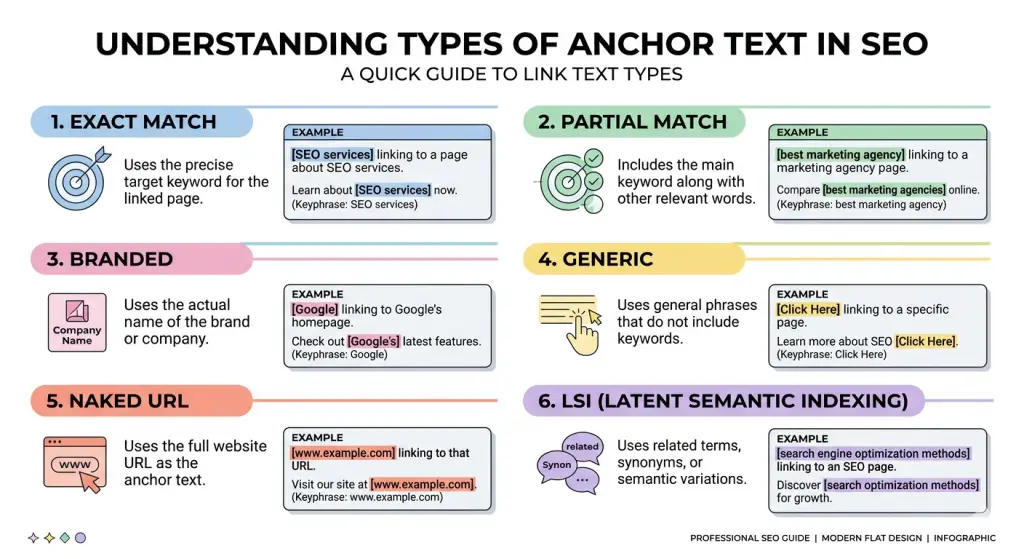
Exact Match Anchor Text
Exact match anchor text contains a keyword or keywords in question, verbatim. If the focus keyword is “types of anchor text in SEO”, the anchor text would be:
types of anchor text in seo
This type allows giving strong ranking signals but at the same time, provokes Google penalties in cases of overuse. This type gives strong ranking signals but its overuse results in penalties from Google; hence, it is used tactically in quality content.
Partial Match Anchor Text
Partial match anchor text has a variation of the target keyword along with other words. For example; Learn about different anchor text types.
The same keyword density requirement is met here, except the repetition is more natural this time (SEO Services San Diego | SEO Company San Diego). However, this practice is widely considered a ‘safe SEO practice’ (Nielsen Norman Group, n.
Branded Anchor Text
Branded anchor text contains the name of a company or brand as a clickable link. For example; “Branded anchor text is when the name of a company or brand is used as the clickable link (Ez-ma, n.d.).
This type also strengthens brand authority, trust signals, and a natural backlink profile. It is essential in brand authority for long-term credibility.
Naked URL Anchor Text
A naked URL anchor text shows the URL instead of a keyword or phrase; A naked URL anchor text means showing the URL in full rather than a keyword or phrase: https://www.example.com.
This is common in citations and references. This is commonly used in citations and references.
Generic Anchor Text
Examples of generic anchor text include statements such as; Click here Find out more Learn more.
Although they do not contain keywords, they enhance user experience and the navigation flow. However, too much of it can dilute SEO value.
Image Anchor Text
When an image is used as a link, the alt text serves as anchor text. For example, an image with the alt text;
SEO anchor text strategies
This can help in link SEO and image SEO.
LSI (Latent Semantic Indexing) Anchor Text
LSI anchor text are Latent Semantic Indexing related keywords rather than exact matches. Example:
link building text variations
This not only helps search engines understand context and how deeply a topic has been covered but also ensures that the content remains relevant without the need for keyword stuffing.
Best Practices for Anchor Text Optimization
Natural Distribution
It takes a healthy ratio of different types of anchor text to maintain a healthy SEO strategy. Over-optimized exact match anchors attract penalties, while a variety of anchor texts proves algorithm-proof.
Relevance and Context First
We make sure that anchor text matches the content of the page it links to. Relevance increases user satisfaction and search engine trust.
No Over-Optimization
Using the same keyword for the anchor text over and over again is manipulative. Instead, anchor texts are varied in the following ways;
Synonymous
Related phrases
Branded terms
This will warrant a natural backlink profile.
Use Descriptive Anchor Text
Anchor texts should have a description of what is contained in the link. Instead of vague phrases, the following is used:
Click here
SEO Anchor Text Strategy Guide
This way both SEO value and user engagement are improved.
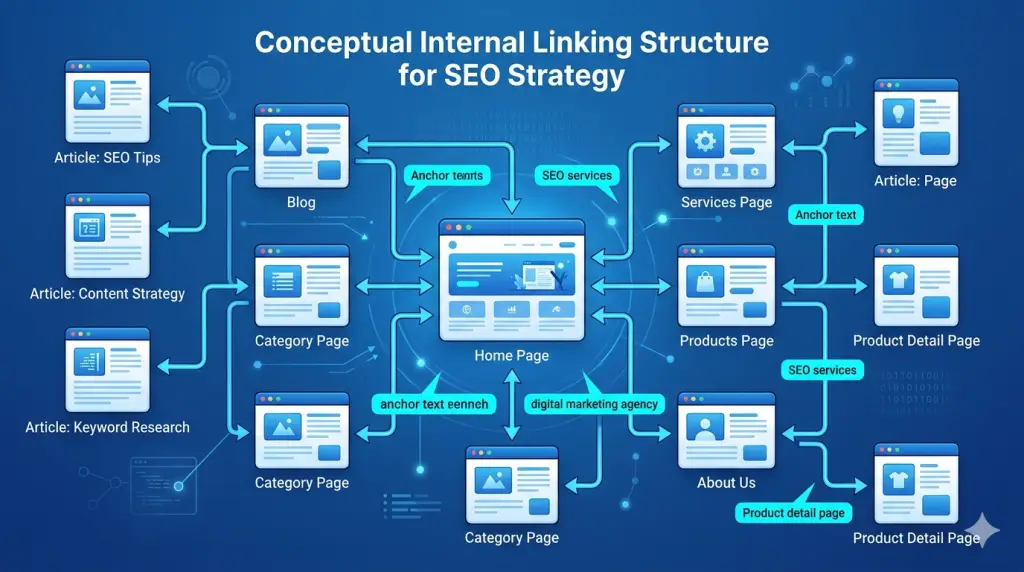
Internal Linking Optimization
Internal links aid in distributing link equity within a site. Internal anchor text diversity enhances:
Crawlability
Indexing
Keyword association
Common Anchor Text Mistakes to Avoid
Anchor Text Keyword Stuffing
First, too much use of exact keywords is a clear sign of manipulation. Repeating the same keyword unnaturally is avoided.
Irrelevant Linking
Using anchor text that has nothing to do with the page being linked to confuses the users and the search engines as a result hurting the trust.
Overuse of Generic Anchors
While generic anchors enhance the usability, excessive use of generic anchors diminishes the SEO performance.
Ignoring Brand Anchors
Neglecting branded anchor text causes a loss of authority. Branded anchor text is also not forgotten and neglected, as this weakens authority.
Advanced Anchor Text Strategies for Higher Rankings
Anchor Placement Based on Content
Anchor text is woven naturally within top-notch content with an easy going flow between the anchor text and the surrounding copy.
Competitor Anchor Analysis
Competitor analysis of backlinks identifies:
Anchor text distribution patterns
Keyword anchors with the best performance
Opportunities To Build Links
Contextual BackLinks
Links that are placed within pertinent content are twice as important as those at the footer or in the sidebar. Contextual Links (Placement in Relevant Content Gets More Weight than Footer/Sidebar Links)
Anchor Text Variation Matrix
We build up a strategic mix;
10–20% exact match
20–30% partial match
30-40% branded
Leftover: generic, naked URLs, and LSI
This ensures a safe and efficient SEO profile.
How Anchor Text Influences Google Algorithms
Search engines use anchor text to find out:
Page relevance
Keyword targeting
Content relationships
This signals authority and rankings without alerting algorithmic penalties like Google Penguin (ibid).
Future of Anchor Text in SEO
The anchor text, thus, is becoming context-driven and not dependent on keywords as the search engines get sophisticated. Focus is shifting to the following:
Semantic relevance
User intent
Content quality
Instead of chasing a myriad of keywords, we introduced relevant natural language, and focusing on creating meaningfully linked content.
Conclusion: Building a Powerful Anchor Text Strategy
Having a good hold on the types of anchor text in SEO helps us to create a balanced, natural and high-performing link profile.
Combining exact match, partial match, branded and LSI anchors in a strategic manner maximizes not only search engine but also users’ visibility.
A refined anchor text strategy is not about manipulation—it is about precision, relevance, and diversity.
When done right, it is one of the most powerful tools to deliver Google rankings and organic growth over time.
Hello all! I am Sanju Yadav, a digital marketing enthusiast from Nepal who has been delving into the world of online marketing, SEO, and social media strategies.
I recently launched my personal website — https://sanjuyadav.com.np/
to share my experience, learning process, and digital marketing insights with all of you.
You can find helpful topics on my website, including:
SEO tips for beginners
Social media marketing ideas
Content writing strategies
Website growth and engagement techniques
Whether you are a student, small business owner, or digital marketing enthusiast, my goal is to help you learn and grow in the digital space.
I'm thrilled to unveil a project I've poured my heart into — my personal website: sanjuyadav.com.np
🎉
This site brings together my passions — digital marketing, SEO, content creation, and creative strategy. You'll discover my recent work, thoughts, and news all in one spot.
Launching this website marks a key milestone in growing my personal brand and digital career. Every visit, share, and piece of feedback means the world to me 🙌
On-page SEO is the basis of a successful online. Your website is like a shop in a crowded market—no matter how great the inside is, if the entrance is not user-friendly or the signboard is not clear, people simply pass by. That’s exactly what happens in the case of on-page SEO being overlooked.
While off-page SEO, which gives more weight to backlinks, is less in your hands, on-page SEO is completely under your control. The principle is to perform the optimization of such components as titles, URL, content, and images so both the search engines and the users can easily grasp what your site is. If done correctly, it leads to a higher level of exposure, better rankings, and a good user experience.
If we consider Google as a strict librarian: if your book (website) has a clear title, index, and chapters, it is recommended more often. On-page SEO is not about fooling algorithms - it is about making the content organized, understandable, and helpful.
This handbook teaches you the basics of on-page SEO with real-life strategies which will get you higher rankings and make visitors stick around.
What is On-Page SEO?
On-page SEOis the adjustments that you make on your site in order to enhance the visibility of your site from a search engine's perspective. It involves making titles with keywords, writing meta descriptions, creating URLs that are easy-to-follow, adding internal links and making images pop with descriptive tags.
To give a concrete example, it is on-page SEO to write an article named “Best Running Shoes for Newbies” with proper headings and visually pleasing images. However, if the article is linked to by another website, that’s off-page SEO.
On-page SEO's power is most evident through its direct influence. Changes such as optimized titles, quicker loading, or adding keywords can raise positions in a short time. Nevertheless, SEO is a continuous process—keeping the strategies up to date is the only way to achieve sustainable results.
Why On-Page SEO Matters
Local SEO will not limit your growth if it has been weak even with the presence of backlinks. Why on-page SEO is significant for you:
Search Engines are Dependent on On-Page Signals – Titles, meta tags, and structure are the main elements that algorithms use as a starting point.
User Satisfaction is One of the Ranking Factors – A good and friendly site always keeps the visitors coming back.
Mutual Benefit for Other SEO Endeavors – Links and ads will not give you the result you want without organic SEO.
Potentially More CTR (Click-Through Rates) – Creating more eye-catching titles and descriptions is a good way to attract more visitors.
In a nutshell, on-page SEO is the best way to grow your organic traffic base over time.
How Search Engines Work
Search engines such as Google employ similar methods to those used by humans to decide what the best answers to users’ queries are. They send crawlers (bots) to search for sites, and the crawlers follow the links, read the content, and categorize it. The ranking of the results is done by fast and smart programs called algorithms, and they rate the returned results based on being helpful, accurate, trustworthy, and user-friendly.
But if your site is missing or has broken titles, data that are not structured correctly, or is not mobile-friendly, then the crawler can come to a wrong conclusion. On-page SEO makes sure that your site is user-friendly for both bots and humans.
Key On-Page Elements Search Engines Evaluate:
Title tags & meta descriptions – How informative and engaging they are
Keywords – The natural way of their usage in the content
Headings (H1, H2, H3) – Giving website a friendly and understandable structure
Internal links – Making navigation and understanding of content easier
Image alt text – Making it possible for people with visual impairments to access and understand the image
Page speed & mobile-friendliness – Making sure that the user is happy
Keyword Research and Optimization
Keywords are the link that ties search queries to your content. Appropriate research is a good mix of relevance, competition, and search volume.
Short-tail keywords (like “shoes”) usually lead to a big number of visitors but with a large competition.
Detailed keywords (such as “best running shoes for flat feet”) pull in targeted, highly converting traffic.
Best Practices for Keyword Placement:
Title tag & H1
First 100 words
Subheadings (H2, H3)
URL slug
Meta description
Image alt text
Internal links
Don’t overuse your keywords. Use related words and different forms of the same word in a natural way, to make both readers and search engines happy.
Keyword research tools: Google Keyword Planner, Ahrefs, SEMrush, Ubersuggest, AnswerThePublic, and Google Trends.
Title Tags and Meta Descriptions
Title tags are what your potential clients or users see when they do a search on a search engine (SERPs). These tags shouldn’t be very long; they have to be very descriptive and should also include your main keyword.
Not longer than 60 characters.
The keyword should be the first or one of the first words.
Numbers, years, or power words (e.g., “Best SEO Tips for 2025”) can be added.
Meta descriptions have a very limited effect on rankings but they can attract users to click on your link. Trying to keep them below 160 characters, putting an important keyword in it and phrasing it as if it was an ad.
Header Tags and Content Structure
One of the front-end user-experience improvements is the headers (H1–H4) feature. Besides its role in readability, it also helps SEO by providing a hierarchy of the content.
H1: The main focus of the page topic (only one allowed per page).
H2s: Big or major sections of the content.
H3/H4s: There are the subtopics or details.
Headers make a glance reading easier for users and are an aid to robots in content identification. Directing users to the desired area through headings can also be an advantage in your getting snippets of selection in feature.
URL Structure and Optimization
Short and descriptive URL is one of the factors in building trust and getting better rankings.
The keyword should be naturally incorporated in the URL.
Keep it concise (not more than 60 characters) and to the point.
Use hyphens instead of underscores.
Avoid using words that are not necessary.
Example:
❌www.example.com/article?id=12345
✅ www.example.com/on-page-seo-guide
Internal Linking and Anchor Text
Internal links not only connect your pages but also improve crawlability and user guidance.
Best Practices:
Use descriptive anchor text (e.g., on-page SEO guide instead of click here).
Choose linking topics that are relevant and related.
Make sure that the most important content (pillar pages) gets the highest number of internal links.
Old posts can be updated with links to new ones.
It is better to have a variety of anchor texts—just be sure to mix exact match, partial match, and branded anchors naturally.
Image Optimization
Optimization is the crucial step because search engines cannot 'view' images.
Alt text: Depict the image briefly and add the keywords in a natural way.
File names: Select terms that are showing what the image is about (e.g., seo-strategy.jpg).
Compression: Tools like TinyPNG or ShortPixel can help you to shrink the file size.
Responsive design: Allowing images to be featured on different devices.
Properly optimized images will result in better rankings, faster loading of the site, and accessibility for users with disabilities.
Mobile-Friendliness and Core Web Vitals
Google employs a mobile-first indexing system, hence the mobile version of your site is what counts the most.
Mobile-Friendly Checklist:
Responsive design
Large, readable fonts
Easy-to-tap buttons
Minimal intrusive pop-ups
Core Web Vitals (Google ranking signals):
LCP: Main content loads <2.5s
FID: Interaction <100ms
CLS: Layout shift <0.1
Speedy, reliable, and user-friendly websites are winners in the competition for top positions in rankings and customers’ loyalty.
Content Quality and SEO Writing
Though content is the king of all. Valuable content even if SEO is done perfectly will not let the site rank.
Do not overuse keywords or copy your content from other sources. Also, make sure that your older publications are revitalized regularly with new ideas and links.
Schema Markup and Structured Data
Schema markup allows search engines to present rich results (stars, FAQs, product info) to users.
Some examples are:
Article schema
Product schema
FAQ schema
Local business schema
Use Google’s Rich Results Test to see if your structured data is valid. Schema increases visibility, CTR, and trust.
Page Speed and Technical Optimization
A slow website is a double-edged sword that kills both rankings and conversions.
Quick Fixes:
Use a CDN
Minify CSS/JS
Enable caching
Lazy-load media
Choose fast hosting
Even a one-second delay can lead to a 7% drop in conversions. Faster sites make users happy and keep them engaged.
Common On-Page SEO Mistakes to Avoid
Keyword stuffing
Ignoring meta tags
Weak internal linking
Not mobile-friendly
Slow page load times
Advanced On-Page SEO Strategies
Once the foundations are in place, you can:
Content clusters: Create pillar pages that have support articles.
LSI keywords: Employ synonyms and related terms to provide context.
Engagement signals: Let the visitors comment, share the post, or even stay on your site for a while.
Conclusion
On-page SEO is the home base of digital success. From titles and headers to speed and mobile usability, every detail counts.
Key Takeaways:
Make the optimization work for search engines as well as humans.
Content depth, structure, and user experience should be the focus of your work.
Never stop improving—SEO is a continuous journey.
A well-crafted on-page SEO strategy is what will make your content appear on the top of the searches, thus driving traffic to you and eventually converting such visitors to loyal customers.


 https://www.example.com.